Last updated: October 18, 2026
How do midterm elections work in the US? Every two years, halfway through a president’s four-year term, voters elect all 435 members of the House of Representatives and about one-third of the Senate. In 2026, that means all 435 House seats and 35 Senate seats on Tuesday, November 3, plus 36 governors and thousands of state and local races. Candidates first win their party’s nomination, usually in a primary, then face each other in the November general election, and winners in Congress take office in early January.
That is the whole thing in a paragraph. The details are where people get lost, though: why only some Senate seats, what a primary actually does, why results can take days, and when the new members start. When I walk first-time voters through it, the same handful of questions come up every cycle. So here is the plain version, with no spin and no team jerseys.
What Makes an Election a “Midterm”
Federal elections in the US happen in every even-numbered year. Every four years, the presidency is on the ballot. The elections in between, two years into a president’s term, are called midterms because they land in the middle of that term.
The president is not on the ballot in a midterm. Congress is. So are most governors, most state legislatures and a long list of local offices, from county sheriffs to school boards. Federal law sets the date: the Tuesday after the first Monday in November. In 2026, the first Monday is November 2, so Election Day is Tuesday, November 3, 2026.
What Is on the Ballot in 2026
Here is a quick look at the main offices, how many are up this year, and how long each term lasts.
| Office | Up for election in 2026 | Term length |
|---|---|---|
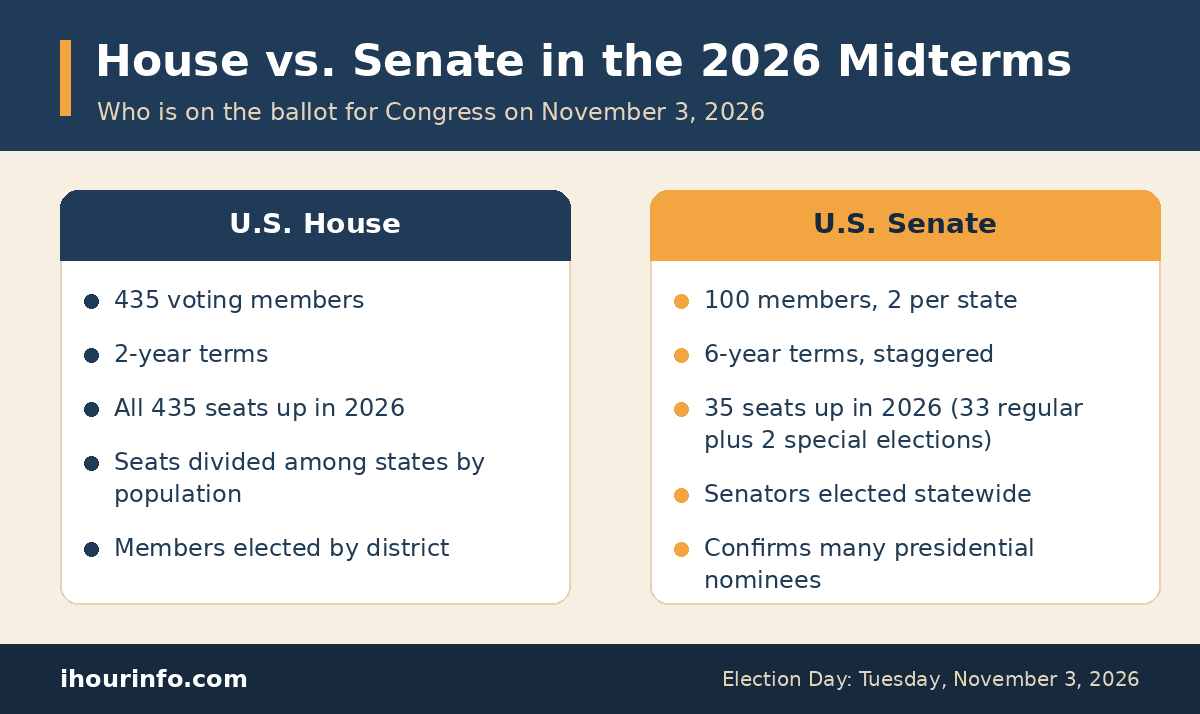
| U.S. House of Representatives | All 435 seats | 2 years |
| U.S. Senate | 35 of 100 seats (33 regular plus 2 special elections) | 6 years |
| Governors | 36 states plus 3 U.S. territories | 4 years in most states; 2 years in New Hampshire and Vermont |
| State legislatures | Seats in most states | Varies by state and chamber |
| Local offices and ballot measures | Varies by state, county and city | Varies |
The House: everyone, every two years
House members serve two-year terms, so every single seat is up in every even-numbered year. Seats are divided among the states by population after each census, and each state draws its own district lines. Some states have redrawn their maps again mid-decade, so if you moved or your district changed, double-check which race you are voting in. Washington, D.C. and five U.S. territories also elect non-voting members of the House. In 2026, five of those six seats are up; Puerto Rico’s resident commissioner serves a four-year term.
The Senate: about one-third at a time
Senators serve six-year terms, and the terms are staggered into three groups. That is why only about a third of the Senate is up in any given election. In 2026, 33 seats are up on the regular schedule. Two more are special elections, in Florida and Ohio, to fill the remaining two years of terms left open when the senators elected there in 2022 resigned in early 2025. That makes 35. Each state has two senators, and they are elected by the whole state, not by district.
Governors and state races
Thirty-six states elect a governor in 2026, along with three U.S. territories. Most governors serve four-year terms; New Hampshire and Vermont elect theirs every two years. Many states also elect attorneys general, secretaries of state and state legislators. Honestly, these down-ballot races shape daily life more than people realize: state lawmakers write rules on schools, roads, taxes and how elections themselves are run.
Ballot measures
Many ballots also include questions voters answer directly. In many states, the legislature can send a constitutional amendment or law to voters, and in roughly half the states, citizens can collect signatures to put a measure on the ballot themselves. These are state and local questions. There are no national ballot measures in the US.
How Candidates Get on the November Ballot
Before the general election, each party picks its nominee. Most states do this with a primary election, and the rules vary more than most people expect.
The main primary types:
- Closed primary. Only voters registered with a party can vote in that party’s primary.
- Open primary. Any registered voter can choose either party’s ballot, without registering with that party.
- Semi-closed or partially open. A mix, for example letting unaffiliated voters pick a party ballot while registered party members stick to their own.
- Top-two primary. All candidates appear on one ballot regardless of party, and the top two finishers advance to November, even if they belong to the same party. California and Washington use this system.
- Runoffs. Some states require a candidate to win a majority in the primary. If no one does, the top finishers meet again in a runoff a few weeks later. Georgia is one example.
A few states also use party conventions as part of the nomination process. Independent and third-party candidates usually reach the ballot by gathering a set number of voter signatures, with requirements that differ by state.
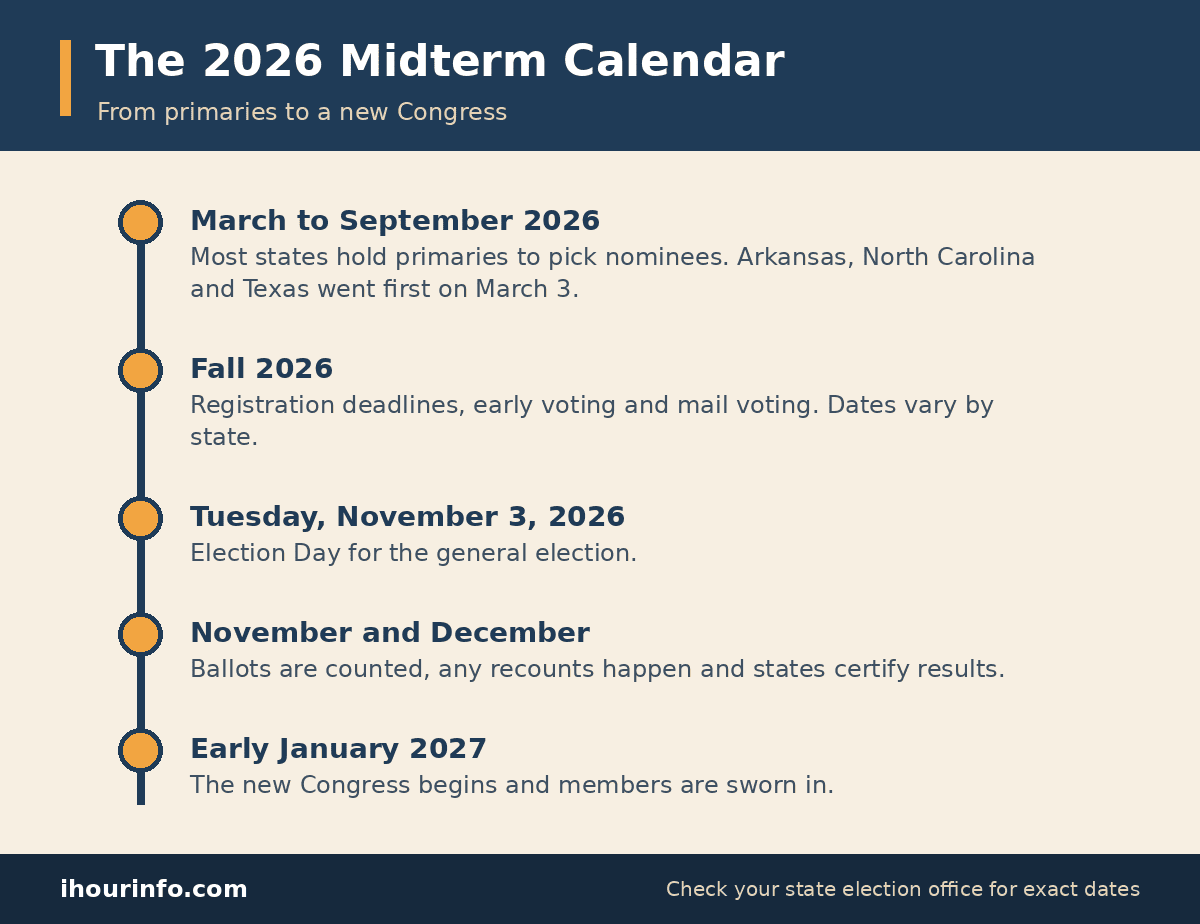
In 2026, the primary season opened on March 3 in Arkansas, North Carolina and Texas, and most states had wrapped up by mid-September. By October, the November matchups are set nearly everywhere.
How Voting Works Before and on Election Day
Elections in the US are run by the states, and in practice by county and local election officials. That is why your neighbor in another state may describe a completely different process. Here are the pieces that apply almost everywhere.
Registration
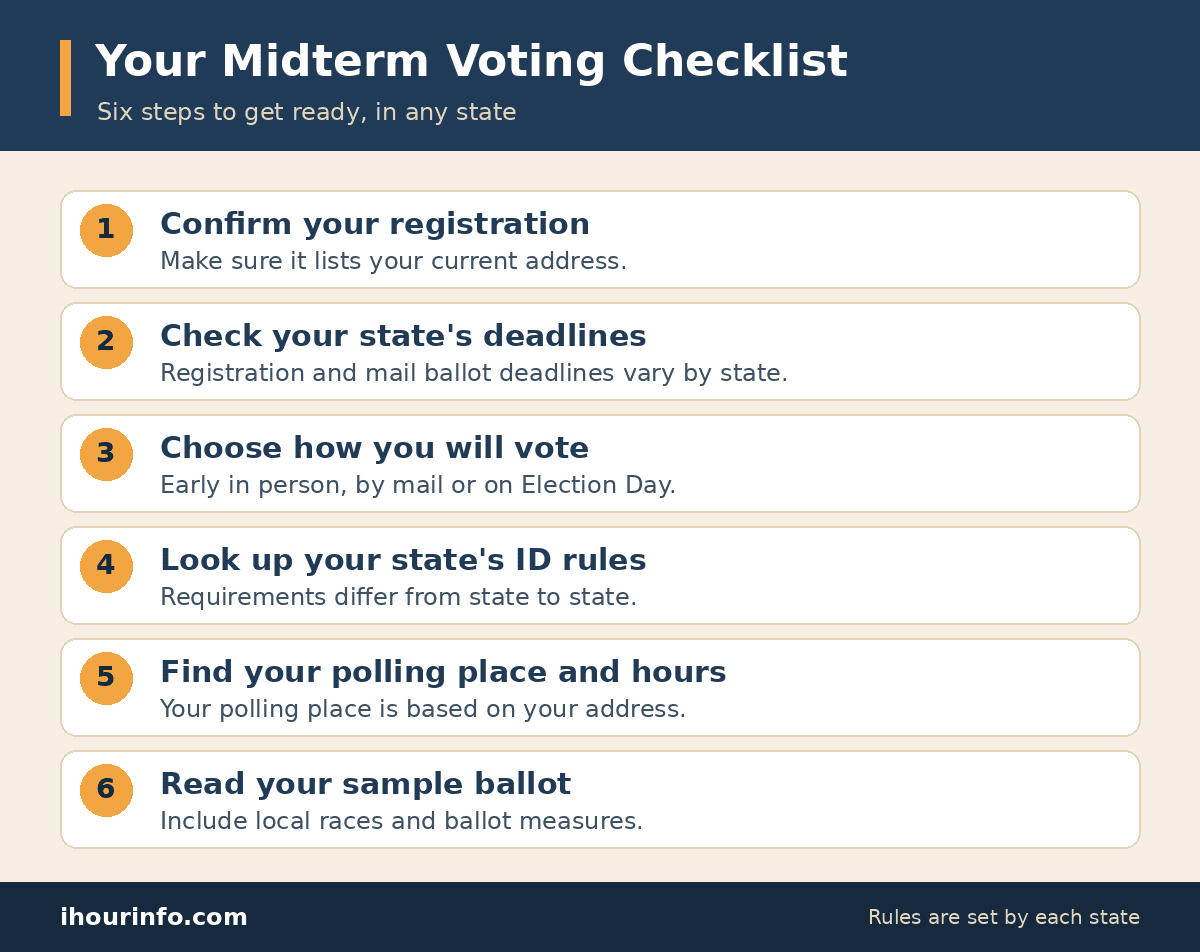
Nearly every state requires you to register before you vote. Deadlines vary. Some states close registration weeks before Election Day, while others allow same-day registration at the polls. North Dakota is the exception that does not have voter registration at all. The official federal site vote.gov points you to your state’s registration rules.
Early voting and mail voting
Most states offer some form of early in-person voting, and every state allows at least some voters to cast an absentee or mail ballot. A handful of states mail a ballot to every registered voter automatically. Others require you to request one, sometimes with a valid reason. Return deadlines differ too: some states count mail ballots only if they arrive by Election Day, while others accept ballots postmarked by Election Day that arrive a few days later.
Election Day itself
On Election Day, you vote at your assigned polling place, which is based on your address. Polling hours are set by each state. ID rules vary widely: some states ask for a photo ID, some accept other documents, and some only ask you to state your name and address.
A practical note: Election Day is not a federal holiday, so most people vote around work. Our list of US federal holidays shows which days are official days off. Some states require employers to give workers time to vote, so check your state’s rules if your shift is long. And in 2026, clocks fall back on Sunday, November 1, just two days before the election. Our guide to when daylight saving time ends in 2026 explains the change, which matters if you plan an early-morning or after-work trip to the polls.
How Results Are Counted and Certified
Election night results are not final results. News organizations project winners based on the votes counted so far, but official results come later, after election officials finish counting every valid ballot, including mail ballots, overseas ballots and provisional ballots.
Close races can take days, and that is normal. Some states are not allowed to start processing mail ballots until Election Day, and some accept ballots that arrive after it, so the count keeps moving. If a race is very close, state law may trigger an automatic recount or allow a candidate to request one.
After the count, each state certifies its results on its own timeline. Then the newly elected members of Congress are sworn in when the new Congress begins in early January 2027. The Constitution sets January 3 as the start date unless Congress passes a law choosing a different day. New governors take office on dates set by each state, often in January.
Why Midterms Matter
Midterms decide which party controls the House and the Senate for the next two years. That affects which bills move forward, how the federal budget gets written, and how much oversight Congress does. The Senate also confirms many presidential nominees, including federal judges and cabinet officials, so Senate control carries extra weight.
Two patterns show up again and again. First, turnout in midterms is usually lower than in presidential years. Second, the president’s party has more often than not lost seats in the House in midterm elections, though there have been exceptions. Neither pattern decides any single race. Local candidates, local issues and who actually shows up to vote do.
How I Explain Midterms to a First-Time Voter
When someone asks me where to start, I skip the national horse race and give them three steps. Confirm you are registered at your current address. Decide how you will vote: early, by mail or on Election Day. Then look up a sample ballot from your county or state election office, because the down-ballot races and measures are where most people feel unprepared.
The sample ballot is the secret weapon. It turns “I do not know half of these names” into a short reading list you can work through over a weekend. I also tell people not to skip races just because they are unfamiliar. A county commissioner or a school board seat can affect your property taxes and your kids’ classrooms more directly than anything in Washington.
If you are a student writing a civics paper or preparing for a debate about elections, the same habits apply: gather facts from official sources, separate claims from evidence and present both sides fairly. Our guide on how to develop a strong argument for your argumentative essay walks through building a case that holds up.
Frequently Asked Questions
What is a midterm election in the US?
A midterm election is the federal general election held two years into a president’s four-year term. All 435 House seats and about one-third of Senate seats are on the ballot, along with many governors, state legislators, local offices and ballot measures. The president is not on the ballot.
When is the 2026 midterm election?
The 2026 midterm general election is on Tuesday, November 3, 2026. Federal law sets Election Day as the Tuesday after the first Monday in November in even-numbered years. Many states also offer early voting and mail voting before that date.
How many Senate seats are up in 2026?
Thirty-five Senate seats are up in 2026. Thirty-three are regularly scheduled elections, and two are special elections in Florida and Ohio to fill the remainder of terms that became vacant in early 2025.
Is the president on the ballot in a midterm election?
No. The president is elected every four years, and midterms happen halfway between presidential elections. Voters choose members of Congress, many governors, state and local officials, and sometimes ballot measures.
Is Election Day a federal holiday?
No. Election Day is not a federal holiday, so most businesses and offices stay open. Some states and employers give workers time off to vote, and many states offer early voting or mail voting to make it easier.
When do newly elected members of Congress take office?
The new Congress begins in early January after the election. The Constitution sets January 3 as the start date unless Congress passes a law choosing a different day, so members elected in November 2026 will be sworn in at the start of January 2027.
The Bottom Line
Midterms are the elections between presidential races. In 2026, voters fill all 435 House seats, 35 Senate seats, 36 governorships and a long list of state and local offices, with Election Day on Tuesday, November 3. Primaries pick the nominees, states run the voting, and official results come after every valid ballot is counted and certified. Check your registration, pick how you will vote and read your sample ballot early. For more plain-language explainers and seasonal guides, browse the Education section on ihourinfo.